Thursday, 19 February 2009

SOCIAL NETWORK

ACCORDING MARK GRANOVETTER, A social network is a social structure which, in general, facilitates communication between a group of individuals or organizations, that are related by one or more specific types of interdependency, such as: a special or common interest; shared values; visions, ideas, or perhaps ideals; financial exchange, friendship, , dislike, conflict or trade.


ACCORDING TO ME SOCIAL NETWORK:

NETWORK:INTERCONNECTION OF TWO NODES IS CALLED NETWORK

SOCIAL:RELATION SHIP STATUS BETWEEN ONE PERSON TO OTHER IN AN ORGANIZATION IS CALLED SOCIAL

SOCIAL NETWORK MEANS CONNECTION FROM ONE PERSON TO ANOTHER PERSON IN AN ORGANIZATION OR CONNECTION OF ONE PERSON TO ANOTHER PERSON IN AN WORLD IS CALLED SOCIAL NETWORK.


REFERNCES:

Adler, P., & Kwon, S. (2002). Social capital: Prospects for a new concept. Academy of Management Review, 27(1), 17-40.

Ahuja, G. (2000). Collaboration networks, structural holes, and innovation: A longitudinal study. Administrative Science Quarterly, 45(3), 425-455.

Ahuja, M., & Carley, K. (1998). Network structures in virtual organizations. Journal of Computer Mediated Communication, 3(4).

Alba, R. D. (1973). A graph-theoretic definition of a sociometric clique Journal of Mathematical Sociology, 3, 113-126 .

Alba, R.D., & Kadushin, C. (1976). The intersection of social circles: A new measure of social proximity in networks. Sociological Methods and Research, 5, 77-102.

Albrecht, T., & Adelman, M. (1987). Communication networks as structures of social support. In T. Albrecht & M. Adelman (Ed.), Communicating social support. Newbury Park, Sage.

Alexander, M., & Danowski, J. (1990). Analysis of an ancient network. Social Networks, 12, 313-35.

Alkire, A., M. Collum, J. Kaswan, & L. Love. (1968). Information exchange and accuracy of verbal communication under social power conditions. Journal of Personality and Social Psychology, 9(4), 301-308.


SOCIAL NETWORK

LIFE CYCLE OF KNOWLEDGE MANAGEMENT


ACCORDING TO ME LIFE CYCLE OF KNOWLEDGE MANAGEMENT

1.STORING

2.ACCESSING

3.USING

THAT IS THE LIFE CYCLE OF KNOWLEDGE MANAGEMENT.

IT WILL INCLUDE

1.IMPLICT(INTANGIBLE ASSESTS AND EXPERTISE)
2.EXPLICT(TANGIBLE INFORMATION AND ASSESTS)

STORING:

STORING THE KNOWLEDGE MEANS WHAT EVER WE KNOW ABOUT THE SOME THING (I.E BUSSINESS MATTERS)FIRST OBSERVING AND STORING THEM IN YOUR MIND OR IN YOUR ORGANIZATION.

ACCESSING:

ACCESSING MEANS WHAT EVER WE KNOW WE SHOULD PLAN HOW TO USE THAT STORED INFORMATION TO ACHEIVE OUR ORGANIZATION GOAL IS KNOWN AS THE ACEESSING.

USING:

STORING THE DATA AND ACCESING THEM AND JUST USING THAT TO ACHEIVE OUR ORGANIZATION SPECIFIC GOAL IS KNOWN AS THE USING THE KNOWLEDGE WHAT WE KNOW.

ACCORDING TO ME THAT IS THE LIFE CYCLE OF KNOWLEDGE MANAGEMENT.


for example

the proffessors any part of he world they first store the data in their mind and they verify alot of books i.e they acessing and they will use that one to teach that one to the stduents is known as the life cycle of knowledge management.

REFERNCES:
1
2
Adams, A., The Implications of Users' Privacy Perception on Communication and Information Privacy Policies, in Proceedings of Telecommunications Policy Research Conference, Washington DC, 1999
3
Adams, A., Sasse, M. A., Privacy in multimedia communications: protecting users not just data, in Proceedings of IMH HCI, 2001, pages 49--64
4
Batson, T., Electronic Portfolio Boom: What's it all about? Syllabus 2002, available online at http://www.syllabus.com/article.asp?id=6984
5
Cohn, E. R., Hibbitts, B. J., Beyond the Electronic Portfolio: A Lifetime Personal Web Space, 2004, available online at http://www.educause.edu/apps/eq/eqm04/eqm0441.asp.
6
7


COMMUNITY OF PRACTISE

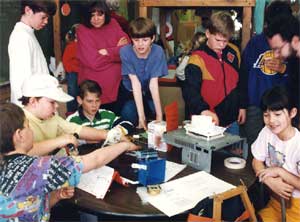
Learning Together:
Children and Adults in a School Community

Barbara Rogoff, Carolyn Goodman Turkanis, & Leslee Bartlett. New York: Oxford University Press, 2001.
$15.95; discounted to $12 if ordered online:
http://www.oup-usa.org/isbn/0195160312.html

Finalist for the Maccoby Award of the American Psychological Association.

This book explores the idea that children (and adults) learn effectively when they are involved with others who share their interests, building understanding together. In such a community of learners, children contribute to planning learning activities, as do adults, and adults learn from their involvement with the children as well as fostering children's learning. Children (and adults) are motivated to be involved in learning for the sake of accomplishing meaningful, productive activities.

The book illustrates principles of learning as a community with observations in an innovative public elementary school in which collaboration among children and between children and adults is central. (It is a public school in which parents spend 3 hours per week in instructional activities in the classroom.) The book was written collaboratively by Barbara Rogoff with teachers, parents, and students.

but in my view of community of prcatise means every body sharing the common task doing indidually and finally bring all together after completing the certain task what they have taken is known as the community of prcatise

for example in a software like infosys

they will be having a very big project and in that project they will divide that project into certain modules and give to specfic members of the different department and finally after completing that one they will combine all the task that is konown as the community of practise.

REFERNCES:

1
Biggs, J. (1999) Teaching for Quality Learning at University. Buckingham: Open University Press.
2
Bowden, J.A. and Walsh, E. (eds) (1994) Phenomenographic Research: Variations in Method. Melbourne, Royal Melbourne Institute of Technology.
3
Brown, JS, Collins, A, Duguid, P. 1989, Situated Cognition and the Culture of Learning, Educational Researcher, 18 (1), 32-34.
4
5
Ramsden, P. (1992) Learning to Teach in Higher Education. London: Routledge.
6
Ramsden, P. (1998) Learning to Lead in Higher Education. London: Routledge.
7
Trigwell, K. (1995) Increasing Faculty Understanding of Teaching. In Teaching Improvement Practices. 76- 100. WRIGHT, W. (ed). Bolton, MA, Anker.


STRATGIE

STRATGIE:

IN MY POINT OF VIEW STRATGEY MEANS A MODE PLAN DESIGNED TO ACHEIVE A GOAL IS KNOW AS STRATGIE IT IS NOT A LONG TERM GOAL OR SHORT TERM GOAL.

EXAMPLE:

HAVING A STRATGIE TO PAY THE UNIVERSITY INSTALLMENTS FEE IS NO THING BUT A STRATGIE .


but according to the michael porter 1979,he has developed five force anylasis it should be used at the industry levelREFERNCES:
  1. ^ Sharp, Byron; Dawes, John (1996), "Is Differentiation Optional? A Critique of Porter's Generic Strategy Typology," in Management, Marketing and the Competitive Process, Peter Earl, Ed. London: Edward Elgar.
  2. ^ Speed, Richard J. (1989), "Oh Mr Porter! A Re-Appraisal of Competitive Strategy," Marketing Intelligence and Planning, 7 (5/6), 8-11.
  3. ^ Yetton, Philip, Jane Craig, Jeremy Davis, and Fred Hilmer (1992), "Are Diamonds a Country's Best Friend? A Critique of Porter's Theory of National Competition as Applied to Canada, New Zealand and Australia," Australian Journal of Management, 17 (No. 1, June), 89-120.
  4. ^ Allio, Robert J. (1990), "Flaws in Porter's Competitive Diamond?," Planning Review, 18 (No. 5, September/October), 28-32.


ORGANIZATION

In my point of view organization means group of people working with the common task to acheive the same goal is know an as organization.

ACCORDING TO JOHN CHILD 1984 THERE are three main accepts to organization which consist attainment of objectives first structure is contributies successfully implementation of plans by formally allocating people and the resource to the task what we have done is called basic structure organization.


second one is that to indicate to the members of an organization more clearely what is expected of them by means of various structural operation mechanism.

the third one is encompasses provision for the assisting decision making and information processing requirements these may be called decision mecchanism.

REFERENCES:

1
Abilene (2004). Abilene Community. Available: http://abilene.internet2.edu/community.
2
Boudreau, M.C., Loch, K. D., Robey, D., and Straub D. (1998). "Going Global: Using Information Technology to Advance the Competitiveness of the Virtual Transnational Organization," Academy of Management Executive, Vol. 12, No. 4, pp. 120--128.
3
Burns, J., and Barnett, M. (1999). "Communicating for Advantage in the Virtual Organization," IEEE Transactions on Professional Communication, Vol. 42, No. 4, pp. 215--222.
4
Byrne, J. A. (1993). "The Virtual Corporation," Business Week, Vol. 3304, pp. 989--1102.
5
Child, J., and Faulkner, D. (1998). Strategies of Cooperation: Managing Alliances, Networks, and Joint Ventures, Oxford-New York: Oxford University Press.
6
7


DATA INFORMATION KNOWLEDGE

Data, Information and Knowledge is the most confusing terms in Knowledge Management. In my view data and information go hand in hand. In simple words it takes the same meaning, but this can change from person to person and also depends on how they view it for a particular situation in an organisation.


When I think about it, I remember Stenmark (2002) has clearly described data, information and knowledge are linear and one directed. In my observation I feel data is a raw fact or figure which serves no purpose but when the fact is processed it is represented as information and when this is used in oneself it is known as knowledge.


Knowledge can be sub divided as external and internal or explicit and tacit knowledge. Explicit knowledge is the knowledge that have been captured and stored in computer environments may be shared by applications and users. example: storing of employment information in the database for the future reference of the organisation (Richard C. Hicks; Ronald Dattero; Stuart D. Galup, 2007).Tacit knowledge is the knowledge needed to select an appropriate computer program, data set, sequence of functions to perform, output, and analysis within yourself (Richard C. Hicks; Ronald Dattero; Stuart D. Galup, 2007).
IN MY POINT OF VIEW OF DATA, KNOWLEDGE MANAGEMENT MEANS


DATA IS WE ARE COLLECTING THE DATA AND INFORMATION MEANS WHAT EVER KNOW REGARDING THAT ONE AND KNOWLEDGE MEANS OVERVIEW OF THE TOPIC IS KNOWN AS THE KNOWLEDGE.
REFERENCE

[1] Beijerse R. P. (1999), “Questions in knowledge management: defining and conceptualising a phenomenon”, Journal of Knowledge Management Vol. 3 No. 2 1999. pp. 94-109 [accessed on 17th January, 2009]

[2] Nonaka, I. and Takeuchi, H. (1995), The Knowledge Creating Company, Oxford University Press, New York, NY [accessed on 18th January, 2009].


[3] Nereu F.Kock Jr, Robert J.Mc Queen, Megan Baker, "Learning and process Improvement in knowledge organisations: A critical analysis of four contemporary Myths", pp 1-10 [accessed on 21st January, 2009].


[4] Richard C.Hicks, Ronald Dattero and Stuart D.Galup (2007),"A Metaphor for knowledge management: explicit islands in a tacit sea", journal of knowledge management, vol.11, no.1, pp 5-16 [Accessed on 16th January, 2009].


[5] Stenmark D. (2002), “Information vs. Knowledge: The Role of Intranets in Knowledge Management”, Proceedings of the IEEE 35th Annual Hawaii International Conference on Systems Sciences [accessed on 20th January, 2009].

[6] Wiig, K. M (1993)., Knowledge Management Foundations: Thinking About Thinking – How People and Organization Create, Represent, and Use Knowledge, Schema Press, Arlington, TX.[accessed on 18th January, 2009].


[7] Wilson, T.D. (2002),”The nonsense of Knowledge Management”, Information Research, vol. 8, no. 1, [Available at: http://www.jiscmail.ac.uk/cgi-bin/wa.exe?A2=ind0112&L=know-org&P=R224&I=-3, accessed on 20th January, 2009]