Learning Together:
Children and Adults in a School Community
Barbara Rogoff, Carolyn Goodman Turkanis, & Leslee Bartlett. New York: Oxford University Press, 2001.
$15.95; discounted to $12 if ordered online:
http://www.oup-usa.org/isbn/0195160312.html
Finalist for the Maccoby Award of the American Psychological Association.
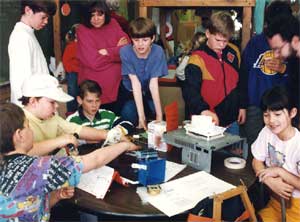
This book explores the idea that children (and adults) learn effectively when they are involved with others who share their interests, building understanding together. In such a community of learners, children contribute to planning learning activities, as do adults, and adults learn from their involvement with the children as well as fostering children's learning. Children (and adults) are motivated to be involved in learning for the sake of accomplishing meaningful, productive activities.
The book illustrates principles of learning as a community with observations in an innovative public elementary school in which collaboration among children and between children and adults is central. (It is a public school in which parents spend 3 hours per week in instructional activities in the classroom.) The book was written collaboratively by Barbara Rogoff with teachers, parents, and students.
but in my view of community of prcatise means every body sharing the common task doing indidually and finally bring all together after completing the certain task what they have taken is known as the community of prcatisefor example in a software like infosys
they will be having a very big project and in that project they will divide that project into certain modules and give to specfic members of the different department and finally after completing that one they will combine all the task that is konown as the community of practise.
REFERNCES:
| 1 | Biggs, J. (1999) Teaching for Quality Learning at University. Buckingham: Open University Press. | |
| 2 | Bowden, J.A. and Walsh, E. (eds) (1994) Phenomenographic Research: Variations in Method. Melbourne, Royal Melbourne Institute of Technology. | |
| 3 | Brown, JS, Collins, A, Duguid, P. 1989, Situated Cognition and the Culture of Learning, Educational Researcher, 18 (1), 32-34. | |
 | 4 | |
| 5 | Ramsden, P. (1992) Learning to Teach in Higher Education. London: Routledge. | |
| 6 | Ramsden, P. (1998) Learning to Lead in Higher Education. London: Routledge. | |
| 7 | Trigwell, K. (1995) Increasing Faculty Understanding of Teaching. In Teaching Improvement Practices. 76- 100. WRIGHT, W. (ed). Bolton, MA, Anker. |

No comments:
Post a Comment